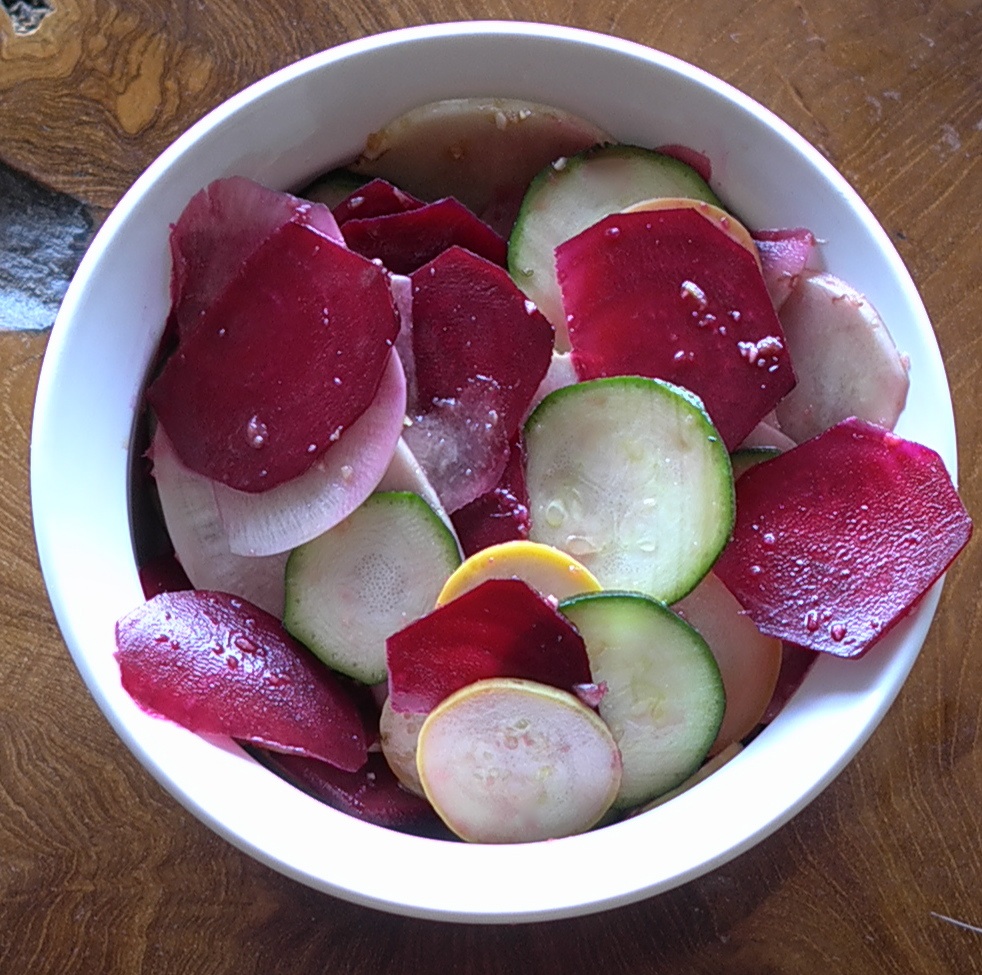
If you want to use up a bunch of your root vegetables but don’t feel like turning on the oven, this is the perfect dish. You can make it in under 10 minutes, and can pretty much use any vegetables you want. The two key tools here are a mandoline and a mini food processor (You can use a blender, too). To make this salad a meal, serve it with the second recipe below, Quick Sesame Peanut Noodles.
Here are the vegetables I used:
- 1 harukei turnip
- 1 red beet
- 1 medium zucchini
- 1 medium yellow summer squash
Other vegetables you can substitute are: carrots, kohlrabi, any other type of beet…
Use a mandoline to thinly slice all of the vegetables and combine in a large bowl. Then, make the dressing:
Dressing Ingredients:
- 1 clove of garlic, roughly chopped
- 1 teaspoon of fresh ginger, roughly chopped
- 2 tablespoons rice vinegar
- 1 tablespoon soy sauce
- 1 teaspoon honey or sugar
- 1 tablespoon olive oil
- 1 teaspoon sesame oil
Directions:
- Place ginger and garlic in mini food processor and process for a few seconds. Scrape down sides if necessary.
- Add vinegar, soy sauce and honey in food processor and blend for another 30 seconds or so.
- Slowly drizzle in oils. I use the itty-bitty hole at the top of the mini-prep so that I can continue to process while adding the oils.
- Pour dressing over salad and combine. Serve immediately.
Bonus Recipe: Quick Sesame Peanut Noodles

Ingredients:
- Banh Pho Noodles (wide, flat rice noodles–I used about 1/3 of the package of the very wide kind, like the type of noodle in Pad Thai)
- a handful or two of raw unsalted peanuts
- 1 teaspoon tahini
- 1 teaspoon soy sauce
- 1-2 tablespoons of scallion, roughly chopped
Directions:
- Cook noodles according to package directions. I put mine in boiling water for about 6 minutes and then drained. Then I returned them to the pot.
- Blend noodles, tahini and soy sauce in a food processor for a 1-2 minutes, scraping down sides as necessary.
- Place peanut mixture in a bowl with 2-3 tablespoons warm water. Stir to combine.
- Pour mixture over noodles and add the scallions.
- Heat up the noodles over medium-low heat for 2-3 minutes, and serve immediately.

Corn and tomatoes play the starring roles in this simple salad, as the scallions and balsamic win best supporting ingredients. They all work together to create an interesting combination of flavors: an end-of-the-summer party in your mouth.
Ingredients:
- 4 ears of fresh corn, cut off from the cob
- 2 tablespoons extra virgin olive oil
- salt
- black pepper
- 2 garlic cloves, minced
- 2 tablespoons balsamic vinegar
- 1 lb cherry or grape tomatoes, halved
- 1/2 cup scallion, coarsely chopped, greens only
Directions:
- Heat oil in a large heavy skillet over medium-high heat. Saute corn and season with salt and pepper to taste. Stir occasionally for about 4 minutes.
- Add the garlic and cook, stirring constantly for 1 minute.
- Add the vinegar and cook, until mostly evaporated, about 1 minute.
- Add tomatoes and cook, stirring gently, 1 minute.
- Lower the heat and add the scallions, stirring to combine. Remove skillet from heat and transfer vegetables to a serving plate. Season with salt and pepper to taste.
The peaches this year have been delicious, and my only complaint is that we cannot eat them all before they spoil. So, I opened up Sherri Brooks Vinton’s preserving book: Put ‘Em Up! and got to work. This week’s preserving projects were Peach Salsa and Peach Leather.
Peach Salsa

Note: If you are planning on canning the salsa, read the information at the bottom of the directions first, since you need to prepare your materials ahead of time. Canning can be a daunting project when working solo. I recommend canning in a small group to ease the stress and add to the fun. Canning is a great way to enjoy the bright flavors of summer in the dead of winter. If you plan on eating or sharing the salsa within a week, no need to can it.
Ingredients
- 3 pounds peaches
- 1 cup cider vinegar
- 1 cup brown sugar, lightly packed
- 1 tablespoon ground cumin
- 1 tablespoon salt
- 1 pound tomatoes, cored, seeded, and diced
- 1 red bell pepper, diced
- 1 jalapeno pepper, diced
- 1 red onion, diced
- 1/4 cup minced fresh cilantro (which I went through the trouble of mincing and then forgot to add it before canning..oops!)
Directions
- Prepare an ice-water bath in a large bowl.
- Bring a large pot of water to a boil. Working in batches of 2 at a time, blanch the fruit in the boiling water for 30 seconds to loosen the skins.
- Scoop the peaches out of the water and plunge them into the ice-water bath. Repeat with the remaining peaches. Drain.
- Combine the vinegar, brown sugar, cumin and salt in a large nonreactive pot. Using a small paring knife, peel, pit, and dice the peaches, adding them to the pot as you go to prevent browning. Add the tomatoes, bell pepper, jalapeno, and onion, and bring to a boil. Reduce the heat and simmer until thickened, about 15 minutes. Add the cilantro (!) and remove from the heat.
- At this point, you can simply ladle the salsa into bowls or jars, and refrigerate for up to a week, covered. OR—You can CAN them so they can stay in the pantry for up to a year. Keep reading to find out how>>>
Canning the peach salsa:
You will need:
- Canner (or large pot with layer of jar rings on the bottom, thread side down) Your container should be large enough that there is at least 2 inches of space above the height of the cans.
- jars (I used 3 pint jars for this recipe, and there was some salsa leftover to eat right away. You can also use double the amount of half-pint jars, as they will require a shorter canner.) You will need extra jars to fill up the canner, so the cans do not tip while processing.
- jar lifter
- jar rings–you can reuse these; just make sure they are clean and free of rust
- jar lids (may only be used once for canning)
- canning funnel
- bubble tool or chopstick
- clean kitchen towels and several paper towels
- Right away, get the canner filled up with water–enough to cover the jars– and heat it up with the lid on. It will take a while to bring to a boil, and you want it to be ready while the salsa is still hot so you can do a hot fill.
- Run the jars in the dishwasher to ensure they will be clean and piping hot when the salsa is ready to go.
- Wash the lids and place them bottom-side down in a small heat-proof bowl. If you don’t have/don’t want to use a dishwasher, you can bring the jars to a boil in the canner once to get them nice and hot.
- Prepare the recipe as outlined above.
- Lay out a clean kitchen towel and have all our equipment nearby.
- Using the canning tongs, remove a jar from the canner, and carefully tip the hot water into the bowl with the jar lids so their sealing rings begin to soften. If your jars were in the dishwasher, just pout hot water over the lids–you can ladle some from the canner.
- Use the canning tongs to remove additional jars from the canner, emptying the water directly back into the canner and placing them, open side up, on a clean kitchen towel.
- Use the canning funnel to fill a jar with the hot salsa, leaving 1/2 inch of headspace.
- Release trapped air with your bubble tool or chopstick.
- Wipe the rim clean with a paper towel, center lids on the jars and screw on the ring until it is finger-tip tight (not knuckle!)
- Repeat steps 7-10 with remaining jars.
- Use the canning tongs to lift the filled jars (be careful not to tip them) and lower them into the canner, being sure they are covered by 2 inches of water.
- Cover the pot and bring the water to a rolling boil. Lower the heat a bit, so the water isn’t rolling out of the pot by still maintains a lot of rolling action. Start timing 15 minutes after the full boil is reached.
- After 15 minutes, turn off the heat and remove the lid from the canner.
- Let the jars cool in the canner for 5 minutes. This way they won’t spurt at you!
- After 5 minutes, use the canning tongs to lift the jars STRAIGHT out of the canner. Do not tip them!! Place them on a clean dish towel-covered counter.
- Let cool overnight. You will need to tighten the jars again. Store them in a cool, dark place for up to one year.
Here are some helpful resources on canning:
http://www.canningusa.com (detailed videos/tutorials)
http://sherribrooksvinton.com: Sherri Brooks Vinton’s site
****************
Peach Leather

Ingredients:
- 2 pounds peaches
- 1 cup water
- 2 tablespoons bottled lemon juice (I used freshly squeezed lemon juice, but that might explain my uneven results)
- 1/4 cup sugar
Directions:
- Prepare an ice-water bath in a large bowl.
- Bring a large pot of water to a boil. Working in batches of 2 at a time, blanch the fruit in the boiling water for 30 seconds to loosen the skins.
- Scoop the peaches out of the water and plunge them into the ice-water bath. Repeat with the remaining peaches. Drain. Using a small paring knife, peel, pit, and roughly chop the peaches.
- Bring the peaches and 1 cup water to a boil in a medium nonreactive saucepan (I used stainless steel). Simmer until they begin to break down, about 5 minutes. Remove the fruit from the heat, let cool slightly, and puree with a traditional blender or stick blender, or by running it through a food mill.
- Preheat the oven to 170 degrees F. Line a jelly roll pan or a rimmed baking sheet with parchment paper or a silpat and set aside.
- Return the puree to the pot and simmer over low heat, stirring frequently, until it thickens to the consistency of baby food. Add the lemon juice and sugar and stir to dissolve.
- Spread the puree on the baking sheet, tilting it to create an even layer about 1/8 inch thick. Dry in the oven until tacky to the touch, about 2 hours. *
- Cool to room temperature. Slide the parchment onto a cutting board and roll the leather into a tube. Slice the tube into 2-inch segments and store in a covered jar for up to 1 month.
*My puree took much longer than 2 hours before it turned tacky, and when it did turn tacky it did so unevenly. Next time, I will try to spread it in a thinner layer, and make sure it is as even as possible. Also, I will try to use bottled lemon juice as this may have caused the problem, too. I’d love to hear how yours comes out!
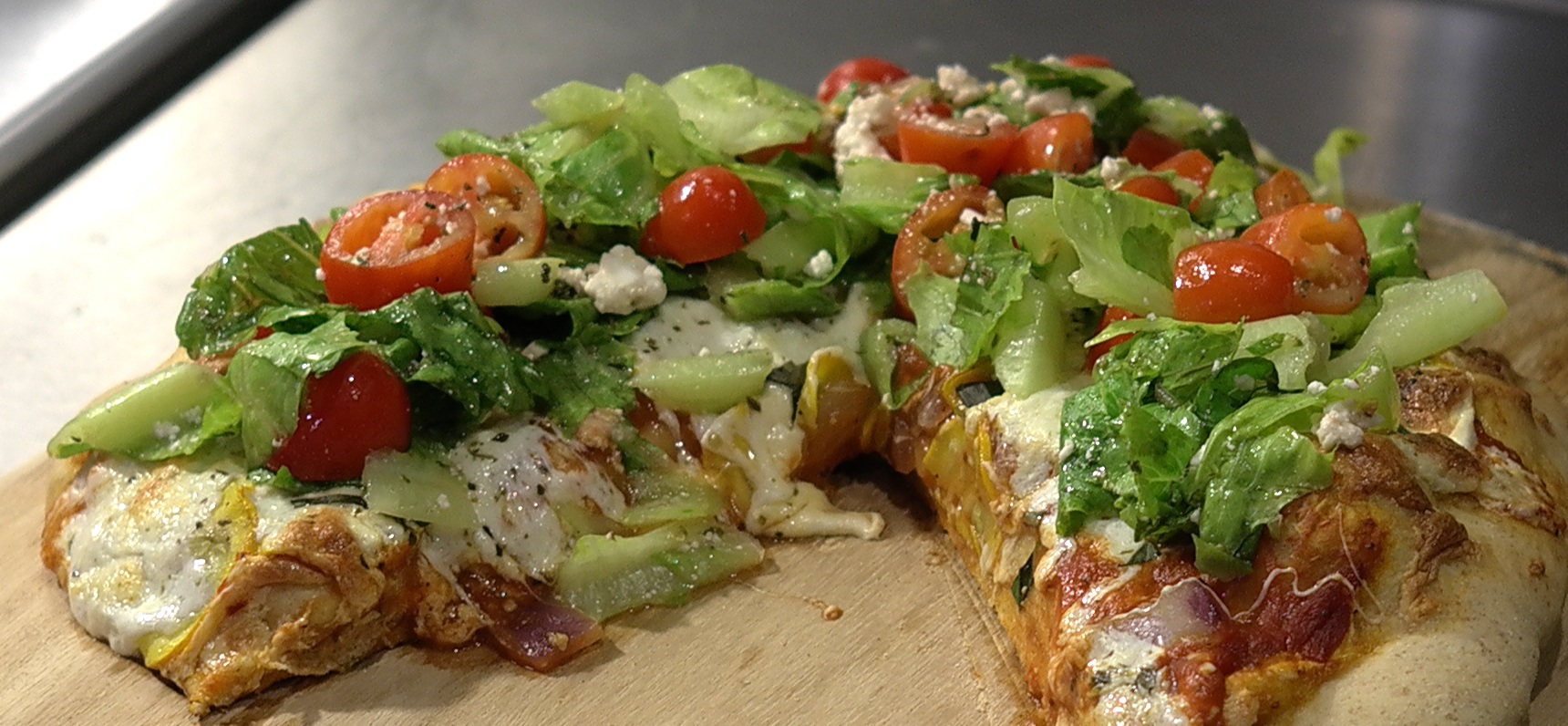
I guess it was inevitable: A Brooklyn blogger writes about pizza. In my opinion, a slice of pizza and a green salad is the perfect meal. Why not pile the greens on top of the pizza? For the dough, you can use store-bought or make your own. Our bread maker has a pizza dough setting which makes dough better than I ever could. I recommend using a pizza stone. Put it in the oven when you start preheating it.
Note: Don’t confuse this “salad pizza” with a “pizza salad”, which I hope to experiment with one day soon!
Ingredients:
The Pizza
- 2 tablespoons olive oil
- 1/2 red onion, diced
- 1 summer squash, sliced thin (I used a mandoline)
- 2 garlic cloves, minced
- 1/8 tsp dried oregano
- 1/8 tsp dried basil
- 1/8 tsp dried thyme
- pizza dough of your choice
- 4-8 ounces quality mozzarella cheese, shredded (how cheesy do you like your pizza?)
- pizza sauce of your choice
The Salad
- 4 cups romaine lettuce, chopped
- 1 cup cherry tomatoes, halved
- 2 tsp olive oil
- 2 tsp red wine vinegar
- 1/4 tsp salt
- 1/8 tsp freshly ground black pepper
- 4 leaves of fresh basil, roughly chopped
Directions
- Preheat oven to 450 degrees and place pizza stone in the oven.
- Add 2 tablespoons olive oil to a skillet. Saute squash, onions, garlic, oregano, basil, and thyme for 8-10 minutes over medium heat. Remove from heat and allow to cool.
- Meanwhile, prepare your dough, depending on the type you have. Sprinkle half of the cheese on the dough. Spread the tomato sauce on top, and then layer the squash mixture. Add the second layer of cheese. Place pizza in oven, and cook for 12-15 minutes.
- While the pizza cooks, whisk together tsp red wine vinegar, 1/4 tsp salt and 1/8 tsp freshly ground black pepper. Slowly drizzle in the olive oil until combined. Toss with the lettuce and tomatoes. (You can add some fresh mild cheese here as well)
- Take pizza out of the oven when the cheese starts to turn light brown in a few places. Add chopped fresh basil on top, and allow to cool for 5 minutes.
- Pile the greens on top of the salad…Slice, and enjoy!
This salad is a slightly different take on Rick Bayless’ version in Mexican Everyday.

The Salad:
- 1 jicama, peeled and cut into sticks (use a paring knife rather than a vegetable peeler)
- 2 avocados, cut into 1 inch pieces (Here are tips on how to cut an avocado)
- 1 medium bunch watercress, large lower stems broken off (You can substitute arugula)
- 4 large romaine leaves, cut cross-wise into 1/4 inch slices
The Dressing:
- 3/4 cup oil (I used a combination of vegetable and olive oil)
- 1/3 cup fresh lime juice
- A few squeezes of fresh orange juice (I used navel oranges)
- 1/2 teaspoon grated lime zest
- 1/2 cup roughly packed cilantro
- 2 serrano chiles (or 1 jalapeno) stemmed and roughly chopped
- 1 teaspoon salt
Directions:
- Combine all the dressing ingredients in a blender and blend until smooth. Pour into a jar and secure the lid.
- In a large bowl, combine salad ingredients. Give the dressing another shake to make sure it is combined. Drizzle about 1/3 cup of the dressing on the vegetables. (Save the rest of the dressing in the fridge for another salad). Toss to combine.
- Taste and add more salt if you think necessary. Serve immediately.
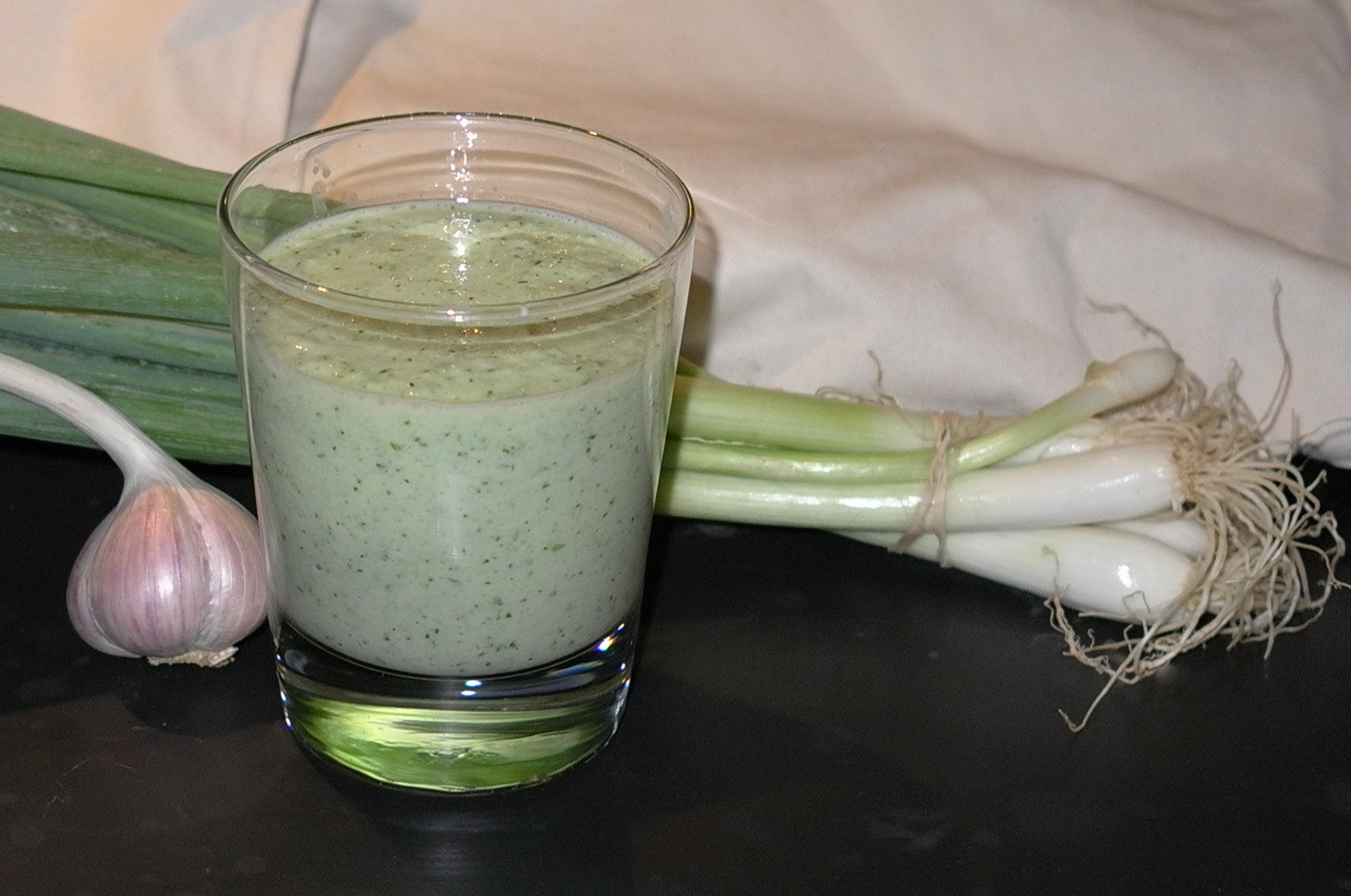
This soup is so refreshing! It is also extremely easy to make. You should prepare this at least a few hours in advance and then allow the flavors to chill in the fridge before serving. The ingredient list is definitely flexible, so feel free to adapt according to taste. Let me know if you make any good adjustments.
*********
Ingredients
- 4 cucumbers, peeled, seeded, and chopped
- 1 cup plain yogurt (I used fage 2%)
- 1 clove garlic, roughly chopped
- 2 scallions, roughly chopped
- 2 tablespoons mint, roughly chopped
- 2 tablespoons dill, roughly chopped
- 1/4 cup lemon juice
- 1/4-1/2 cup water (depending on how much you need to thin it out)
- salt and pepper to taste

While you have the feta and mint ready, here is another summer salad. This one was adapted from Peter Berley’s class. He used farro (spelt) but I had quinoa on hand. Also, he used golden beets–so that the color would not bleed into the rest of the salad. I only had red beets, so I did just added the beets on top at the end, rather than mixing them in with the cucumbers and quinoa.
**********
Ingredients:
- 3-4 beets, cooked, peeled, and diced
Beet Preparation Note (can be done ahead of time and stored in fridge) I roasted in an aluminum foil pouch for about an hour at 400 degrees, testing for done-ness when a fork glided easily through the beets. Depending on the size, it takes about an hour or more. Then, I allowed them to cool. Once cool, I used a paper towel to remove the skins from the beets, and diced.
- 1 cup quinoa, cooked (click here for cooking instructions-see steps 1 and 2)
- 1 large cucumber, peeled, seeded, and diced
- 8 ounces feta cheese, crumbled
- 2 tablespoons chopped dill
- 2 tablespoons chopped parsley
- 1 lemon
Mint Vinaigrette
- 1/4 cup lemon juice
- 2 tablespoons rice vinegar
- 2 tablespoons shallot, finely chopped
- 1/3 cup extra virgin olive oil
- 1 teaspoon sea salt
- fresh ground black pepper
Directions:
- Combine the vinaigrette ingredients in a blender and puree until smooth.
- In a large bowl, combine quinoa, cucumbers and vinaigrette. Mix well. Top with beets. Refrigerate until cold.
- Add the feta, dill, and parsley to the salad. Season with extra lemon juice, salt and pepper to taste. Top with beets.

It seems as if the zucchini in my fridge were multiplying overnight. This Mediterranean recipe
comes from Mark Bittman’s How To Cook Everything Vegetarian. It is a great spin on ratatouille, and helps to solve the problem of the multiplying zucchini.
Ingredients:
- 1 medium or 2 small eggplants
- 1/4 cup extra virgin olive oil
- salt and freshly ground black pepper
- 1 medium zucchini, roughly chopped
- 1 small onion, roughly chopped
- 1 tablespoon minced garlic
- 1 medium tomato, cored and roughly chopped
- 1 tablespoon fresh thyme leaves
- 1 tablespoon freshly squeezed lemon juice
- 1/4 cup minced parsley leaves for garnish
Directions:
- Trim the eggplant and cut it into 1-inch cubes. (If the eggplant is large, soft, or especially seedy, sprinkle the cubes with salt, put them in a colander, and let them sit for at least 30 minutes, preferably 60. Rinse, drain, and pat dry.)
- Put 2 tablespoons of the oil in a large skillet over medium heat. When hot, add the eggplant, sprinkle with salt and pepper, and cook, stirring occasionally, until soft and golden, about 10 minutes. Remove from the pan and drain on paper towels.
- Put the remaining 2 tablespoons oil in the pan and add the zucchini. Cook, stirring occasionally, until just starting to wilt, about 2 minutes. Add the onion and garlic and cook and stir for another minute or two, until soft. Add the tomato and thyme and cook for another minute, until the tomato just starts to wilt and release its juice. Remove from the heat, stir in the lemon juice, and sprinkle with salt and pepper.
- Put the eggplant in a salad bowl and add the vegetables and dressing from the pan. Stir to combine. Cool to room temperature and taste and adjust the seasoning, garnish, and serve. (Or prepare the salad to this point, cover, and refrigerate for up to 2 days; garnish just before serving either cold or room temperature).
Do you ever have extra herbs that just rot in your fridge? Here’s one solution…drink them! These two herb-inspired cocktails are perfect for a summertime party.
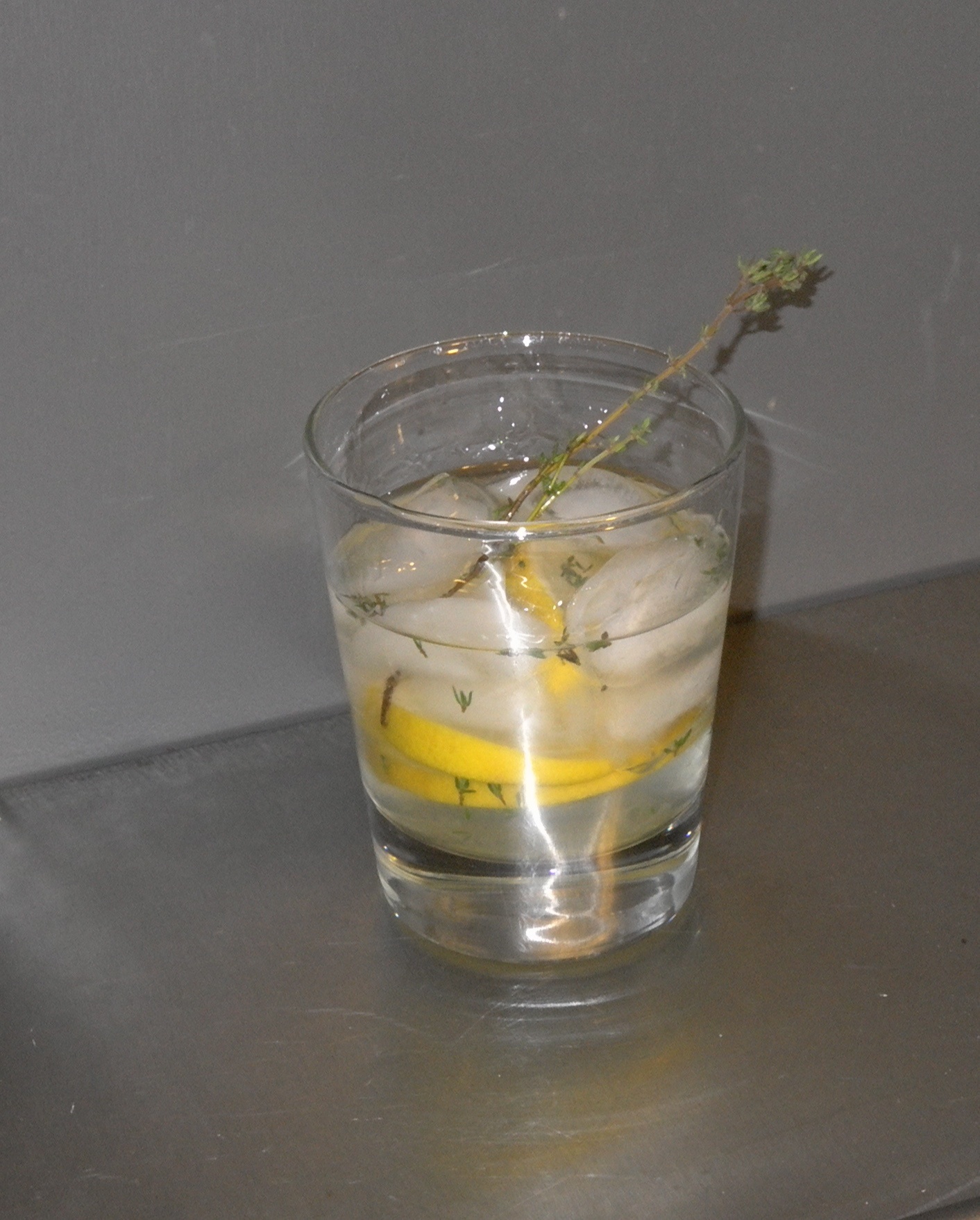
Vodka Thyme Lemonade
Ingredients
- 2 fresh thyme sprigs
- 4 slices lemon
- 2 ounces vodka
- 3 tablespoons sugar or simple syrup (Click here to learn how to make simple syrup)
- Ice and club soda to fill glass
Directions
- Remove thyme leaves from stems and place in glass. Add lemon and sugar. Muddle lightly to release essential oils of herbs and lemon rind, and juices from the pulp.
- Add ice, vodka, and enough club soda to fill glass.
- Toss to mix and serve in a chilled glass with a rim of sugar if desired. Garnish with thyme sprig and lemon slice. Enjoy!
Variations: If you want to get fancy, you can infuse a few thyme springs when you make the simple syrup, so you will have thyme-flavored simple syrup, and then you can skip the part about removing thyme from the stems and placing directly in the glass. This will avoid getting bits-o-thyme in your mouth while sipping the cocktail. You also can make as suggested in the original recipe , and strain prior to serving.
Pimm’s Cup

Ingredients
- 1/4 cup (2 ounces) Pimm’s No. 1
- 6 tablespoons (3 ounces) ginger beer or ginger ale
- 1 cucumber slice
- 1 sprig fresh mint (5 to 6 leaves)
Directions
1. Fill glass with ice.
2. Add Pimm’s, and then top with ginger beer.
3. Garnish with cucumber slice and mint sprig, and serve.
 While spending a warm summer evening out with friends, I got two excellent pieces of advice for this blog.
1.”You really should put a watermelon salad on there.”
2. (after I expressed my concern that I was overusing feta cheese) “Feta makes everything better. Why deny it? Just go with it.”
So here goes. Thanks for the easy recipe, Paul Deen!
Ingredients
- 1 (5-pound) watermelon
- 1 Vidalia or other sweet onion
- 1/4 cup red wine vinegar
- Salt and pepper
- 1/2 cup extra-virgin olive oil
- 2 tablespoons chopped fresh mint
- 4 ounces feta cheese, crumbled
- 6 whole mint sprigs
Directions
Cut the flesh from the melon and cut into bite size pieces, removing and discarding the seeds, and set aside. Peel and slice the onion into rings.
In a small bowl, combine the vinegar, salt, pepper, and whisk until salt is dissolved. Slowly whisk in the olive oil, a few drops at a time. Add in the chopped mint, taste, and adjust seasonings.
In a large bowl, combine the melon, onion, and feta. Pour the dressing over the melon mixture and toss gently until everything is coated and evenly mixed. Garnish with mint sprigs.
To serve, divide salad among individual plates and garnish with mint leaves.

 fresh from brooklyn