The peaches this year have been delicious, and my only complaint is that we cannot eat them all before they spoil. So, I opened up Sherri Brooks Vinton’s preserving book: Put ‘Em Up! and got to work. This week’s preserving projects were Peach Salsa and Peach Leather.
Peach Salsa

Note: If you are planning on canning the salsa, read the information at the bottom of the directions first, since you need to prepare your materials ahead of time. Canning can be a daunting project when working solo. I recommend canning in a small group to ease the stress and add to the fun. Canning is a great way to enjoy the bright flavors of summer in the dead of winter. If you plan on eating or sharing the salsa within a week, no need to can it.
Ingredients
- 3 pounds peaches
- 1 cup cider vinegar
- 1 cup brown sugar, lightly packed
- 1 tablespoon ground cumin
- 1 tablespoon salt
- 1 pound tomatoes, cored, seeded, and diced
- 1 red bell pepper, diced
- 1 jalapeno pepper, diced
- 1 red onion, diced
- 1/4 cup minced fresh cilantro (which I went through the trouble of mincing and then forgot to add it before canning..oops!)
Directions
- Prepare an ice-water bath in a large bowl.
- Bring a large pot of water to a boil. Working in batches of 2 at a time, blanch the fruit in the boiling water for 30 seconds to loosen the skins.
- Scoop the peaches out of the water and plunge them into the ice-water bath. Repeat with the remaining peaches. Drain.
- Combine the vinegar, brown sugar, cumin and salt in a large nonreactive pot. Using a small paring knife, peel, pit, and dice the peaches, adding them to the pot as you go to prevent browning. Add the tomatoes, bell pepper, jalapeno, and onion, and bring to a boil. Reduce the heat and simmer until thickened, about 15 minutes. Add the cilantro (!) and remove from the heat.
- At this point, you can simply ladle the salsa into bowls or jars, and refrigerate for up to a week, covered. OR—You can CAN them so they can stay in the pantry for up to a year. Keep reading to find out how>>>
Canning the peach salsa:
You will need:
- Canner (or large pot with layer of jar rings on the bottom, thread side down) Your container should be large enough that there is at least 2 inches of space above the height of the cans.
- jars (I used 3 pint jars for this recipe, and there was some salsa leftover to eat right away. You can also use double the amount of half-pint jars, as they will require a shorter canner.) You will need extra jars to fill up the canner, so the cans do not tip while processing.
- jar lifter
- jar rings–you can reuse these; just make sure they are clean and free of rust
- jar lids (may only be used once for canning)
- canning funnel
- bubble tool or chopstick
- clean kitchen towels and several paper towels
- Right away, get the canner filled up with water–enough to cover the jars– and heat it up with the lid on. It will take a while to bring to a boil, and you want it to be ready while the salsa is still hot so you can do a hot fill.
- Run the jars in the dishwasher to ensure they will be clean and piping hot when the salsa is ready to go.
- Wash the lids and place them bottom-side down in a small heat-proof bowl. If you don’t have/don’t want to use a dishwasher, you can bring the jars to a boil in the canner once to get them nice and hot.
- Prepare the recipe as outlined above.
- Lay out a clean kitchen towel and have all our equipment nearby.
- Using the canning tongs, remove a jar from the canner, and carefully tip the hot water into the bowl with the jar lids so their sealing rings begin to soften. If your jars were in the dishwasher, just pout hot water over the lids–you can ladle some from the canner.
- Use the canning tongs to remove additional jars from the canner, emptying the water directly back into the canner and placing them, open side up, on a clean kitchen towel.
- Use the canning funnel to fill a jar with the hot salsa, leaving 1/2 inch of headspace.
- Release trapped air with your bubble tool or chopstick.
- Wipe the rim clean with a paper towel, center lids on the jars and screw on the ring until it is finger-tip tight (not knuckle!)
- Repeat steps 7-10 with remaining jars.
- Use the canning tongs to lift the filled jars (be careful not to tip them) and lower them into the canner, being sure they are covered by 2 inches of water.
- Cover the pot and bring the water to a rolling boil. Lower the heat a bit, so the water isn’t rolling out of the pot by still maintains a lot of rolling action. Start timing 15 minutes after the full boil is reached.
- After 15 minutes, turn off the heat and remove the lid from the canner.
- Let the jars cool in the canner for 5 minutes. This way they won’t spurt at you!
- After 5 minutes, use the canning tongs to lift the jars STRAIGHT out of the canner. Do not tip them!! Place them on a clean dish towel-covered counter.
- Let cool overnight. You will need to tighten the jars again. Store them in a cool, dark place for up to one year.
Here are some helpful resources on canning:
http://www.canningusa.com (detailed videos/tutorials)
http://sherribrooksvinton.com: Sherri Brooks Vinton’s site
****************
Peach Leather

Ingredients:
- 2 pounds peaches
- 1 cup water
- 2 tablespoons bottled lemon juice (I used freshly squeezed lemon juice, but that might explain my uneven results)
- 1/4 cup sugar
Directions:
- Prepare an ice-water bath in a large bowl.
- Bring a large pot of water to a boil. Working in batches of 2 at a time, blanch the fruit in the boiling water for 30 seconds to loosen the skins.
- Scoop the peaches out of the water and plunge them into the ice-water bath. Repeat with the remaining peaches. Drain. Using a small paring knife, peel, pit, and roughly chop the peaches.
- Bring the peaches and 1 cup water to a boil in a medium nonreactive saucepan (I used stainless steel). Simmer until they begin to break down, about 5 minutes. Remove the fruit from the heat, let cool slightly, and puree with a traditional blender or stick blender, or by running it through a food mill.
- Preheat the oven to 170 degrees F. Line a jelly roll pan or a rimmed baking sheet with parchment paper or a silpat and set aside.
- Return the puree to the pot and simmer over low heat, stirring frequently, until it thickens to the consistency of baby food. Add the lemon juice and sugar and stir to dissolve.
- Spread the puree on the baking sheet, tilting it to create an even layer about 1/8 inch thick. Dry in the oven until tacky to the touch, about 2 hours. *
- Cool to room temperature. Slide the parchment onto a cutting board and roll the leather into a tube. Slice the tube into 2-inch segments and store in a covered jar for up to 1 month.
*My puree took much longer than 2 hours before it turned tacky, and when it did turn tacky it did so unevenly. Next time, I will try to spread it in a thinner layer, and make sure it is as even as possible. Also, I will try to use bottled lemon juice as this may have caused the problem, too. I’d love to hear how yours comes out!
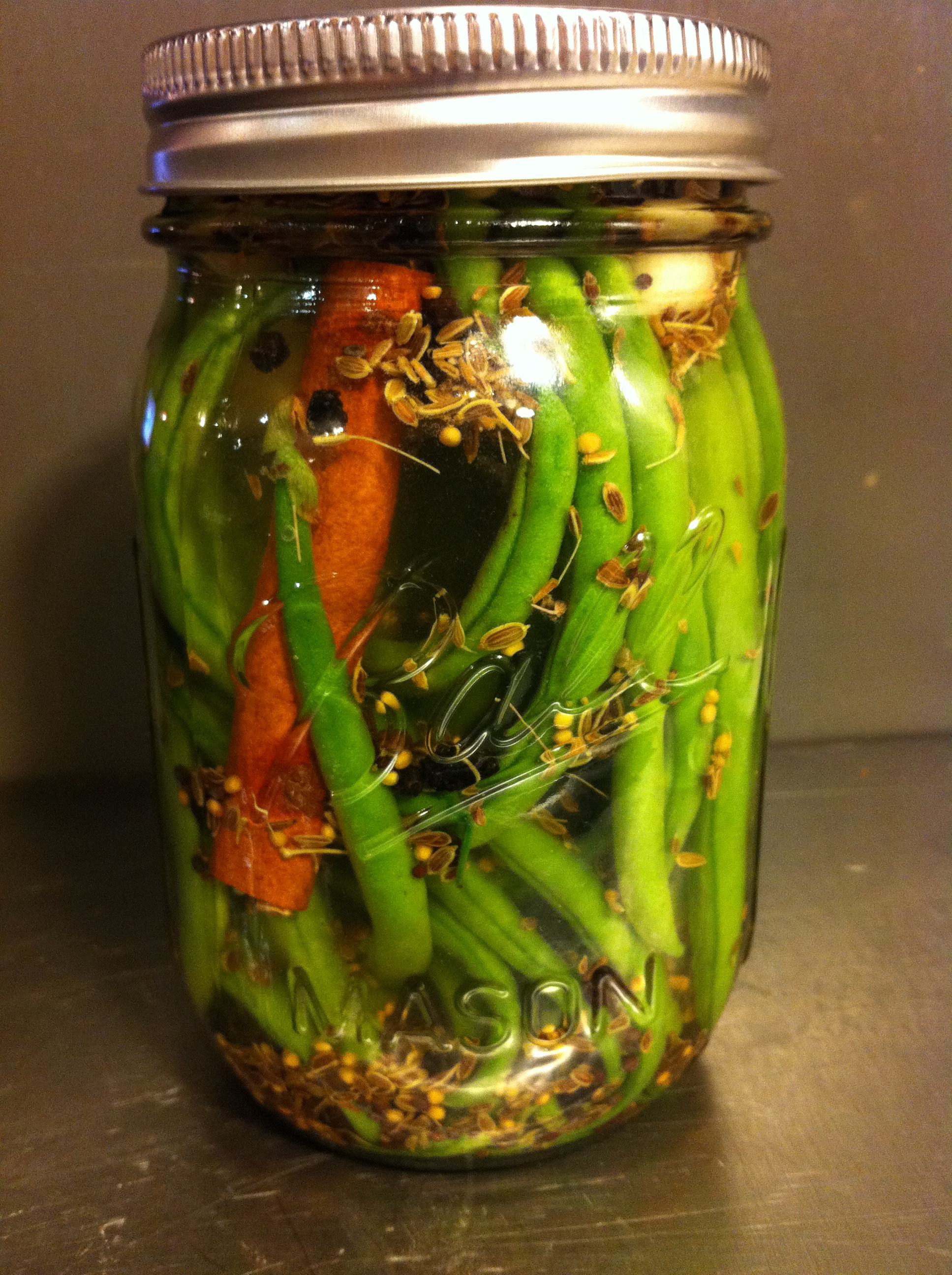
The overflowing farmer's markets in NYC are a sure sign that its time to get pickling.
If all my cookbooks had a contest to see who was the most fun, Karen Solomon’s jam it, pickle it, cure it and other cooking projects would win hands-down. Some of her cooking endeavors are complicated and time-consuming. This one is quick and easy, so easy a child can do it. In fact, I’ve made these pickles with children, and they think its a blast. Solomon recommends garnishing a Bloody Mary with these green beans (skip this step if you are making them with children). They also make a great topping to a salad. You can substitute other vegetables as well: I’ve made pickled carrots, beets, cauliflower, and cucumbers. This recipe is a keeper.
You’ll need 3 clean pint jars with lids. Or if you only have a few green beans, cut the recipe in thirds and make one jar. I just stuck this batch in the fridge, so I did not need to obsess about readying my equipment and keeping a sterile laboratory-type environment. I’ll post more on canning another time. For now, here’s an amazingly easy recipe to try.
Ingredients:
3 pounds green beans, stems intact, washed and dried
9 cloves garlic, crushed
3 cinnamon sticks
3 bay leaves
3 tablespoons yellow mustard seeds
3 tablespoons brown mustard seeds
6 tablespoons dill seeds
3 tablespoons black peppercorns
6 teaspoons kosher salt
1 1/2 to 2 1/4 distilled white vinegar
Directions
Add one third of the green beans, garlic, spices and salt to each jar. Fill each halfway with vinegar (about 1/2 to 3/4 cups). Top off each jar with cool water. Seal each jar with a lid, and shake gently to dissolve the salt and distribute the spices. Refrigerate for at least 3 days.
The green beans will be ready to eat in 3 days, but will taste the best in 2 weeks. They should stay good in the fridge for about 1 month.
 I was excited to find the farmer’s market overflowing with strawberries Saturday morning. I used my new Preserves Handbook (The River Cottage Preserves Handbook by Pam Corbin) to make this delicious and photogenic strawberry jam.
If you are going to can these, you’ll want to start sterilizing the jars before cooking the jam. That’s because you need to do a “hot fill,” meaning you need to fill the jars while the jam is still hot, and seal them immediately to keep it nice and clean inside. On the other hand, if you just want to put them in the fridge for a while and will eat them sooner, then there is no need to sterilize.
UPDATE: This jam turned out to be VERY sweet. You may want to adjust accordingly if you plan on just putting it directly into the fridge. Not sure how that will affect the canning process, since sugar helps to keep the jam fresh.
2 1/4 pounds strawberries, hulled, large ones halved or quartered
2 1/2 cups granulated sugar
2 1/4 cups granulated sugar blended with 1 teaspoon pectin powder
2/3 cup lemon juice
Put 7 ounces of the strawberries into a preserving pan (I used a large, heavy-bottomed stockpot) with 1 cup of the plain granulated sugar. Crush to a pulp with a potato masher (I used a fork). Place the pan over gentle heat and, when the fruit mixture is warm, add the rest of the strawberries. Bring to a very gentle simmer, agitating the bottom of the pan with a wooden spoon to prevent the fruit from sticking. Simmer for 5 minutes to allow the strawberries to soften just a little.
Add the remaining 1 1/2 cups plain granulated sugar and the sugar/pectin mixture. Stir gently to prevent the sugar from sticking and burning on the bottom of the pan. When the sugar has dissolved, add the lemon juice. Increase the heat and, when the mixture reaches a full boil, boil rapidly for 8 to 9 minutes. Then test for the setting point. (I tested by using the dollop test: dipping a clean wooden spoon into the jam, holding it up over the pan, twirling it around a couple of times, and then letting the jam drop from the side of it. The jam should NOT run freely off the spoon. It should instead fall away in small dollops. Mine took closer to ten minutes to get to this point.)
Remove from the heat and, if the surface is scummy, stir gently until the scum has dispersed. Put into sterilized jars. Use within 1 year.

 fresh from brooklyn